




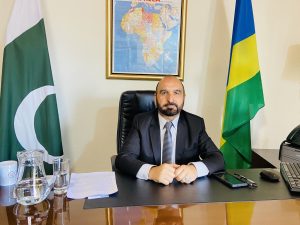
The High Commissioner of Pakistan to Rwanda and Ambassador to Angola and Burundi, His Excellency, has called on the international community to support all initiatives aimed at establishing peace talks between Pakistan and India.
In an interview with PAX PRESS, Ambassador Khan condemned recent Indian attacks on Pakistani civilian infrastructure, which resulted in multiple deaths and injuries. “Pakistan’s position is clear: we are open to any peace talks to resolve all pending issues, including the Kashmir conflict, which remains a disputed area with India,” said Ambassador Khan. “We call on friendly nations and the international community to support and facilitate a peace dialogue in the region,” he added.
Ambassador Khan reminded the international community that both India and Pakistan are nuclear-armed nations. “If the conflict escalates further, it could lead to the use of nuclear weapons,” he warned. “Such a disaster would not only affect our two countries but would pose a threat to the entire world.”
Hostilities between the two nations flared up following the killing of 26 people, including tourists, in an attack in Pahalgam, in Indian-administered Kashmir on April 22, 2025. India accused Pakistan of backing the attackers, while Islamabad denied any involvement.
In response, India suspended the Indus Waters Treaty, terminated visa-free travel, and closed the Attari border crossing. Over 1,500 Kashmiris were arrested, and homes of suspected militants were demolished.
In retaliation, Pakistan rejected India’s unilateral move to suspend the water-sharing treaty and warned that any attempt to restrict Pakistan’s water supply would be seen as “an act of war.” Pakistan also closed its airspace to Indian commercial flights, ended special visa regimes, and suspended bilateral trade.
Violation of the Indus Waters Treaty: A Humanitarian Concern
Ambassador Khan highlighted India’s violation of the Indus Waters Treaty as one of the key causes of ongoing conflict. He accused India of unilaterally withdrawing from the treaty without consulting other parties. The World Bank, which facilitated the treaty, has said its role is limited and will not intervene.
Following the April 22 attack, India cited national security concerns in its decision to suspend the treaty. Ambassador Khan warned that cutting Pakistan’s water supply would devastate agriculture, public health, and the economy, impacting the lives of over 250 million people. “Water should not be weaponized. Even enemies should not use water as a tool of war—it is a matter of humanity,” he said.
End the Blame Game: Focus on Dialogue
Ambassador Khan criticized the mutual accusations of terrorism and urged both countries to end hostilities and prioritize peace. After the April 22 attack, India accused Pakistan of supporting The Resistance Front (TRF), the group believed responsible. Pakistan denied involvement, calling for international investigation and evidence-based dialogue.
Indian Prime Minister Narendra Modi responded by pledging to pursue terrorists “to the ends of the earth,” while Pakistan claimed to have proof of India’s involvement in terrorist activities in Pakistan’s Balochistan province.
Ambassador Khan stated: “Accusations are not the solution. We need negotiations and cooperation. Pakistan wants peace—India should want peace too.” He encouraged both nations to address internal issues such as unemployment, economic development, and scientific progress instead of investing in conflict.
Prime Minister Shehbaz Sharif: Pakistan Ready for Dialogue
Pakistani Prime Minister Shehbaz Sharif reaffirmed his country’s willingness to engage in peace talks. During a visit to Iran, he emphasized that peace between Pakistan and India would benefit not only the two nations but the entire region.
About Pakistan and Kashmir
Pakistan is a South Asian nation, the 9th largest in Asia by area and 5th by population (around 250 million). Islamabad is the capital, and Karachi is the largest city and economic hub. It has the second-largest Muslim population globally as of 2023.
Kashmir Conflict
The Kashmir conflict is a territorial dispute between India and Pakistan. An armed insurgency began in Indian-administered Kashmir in 1989, demanding self-determination or independence. Ambassador Khan proposed a referendum to allow Kashmiris to choose between joining India or Pakistan.
Reports by scholars and human rights groups accuse Indian forces of widespread human rights abuses in Kashmir, including extrajudicial killings and enforced disappearances. Ambassador Khan reiterated Pakistan’s commitment to addressing these concerns through peaceful and democratic means.
By
Albert Baudouin Twizeyimana
Peace Journalism Trainer/PAX PRESS