
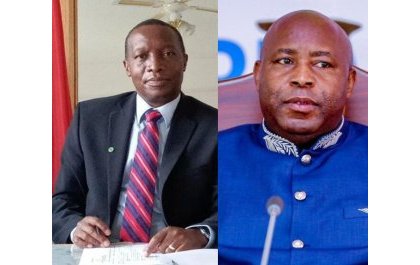
Burundi’s President, Évariste Ndayishimiye, and the country’s Minister of Foreign Affairs have continued to be the subject of ridicule on social media following their contradictory statements regarding Qatar’s role in restoring peace in the Democratic Republic of Congo (DRC).
In recent times, the State of Qatar has played a significant role in efforts aimed at restoring peace in eastern DRC and the region as a whole.
On several occasions, representatives of the AFC/M23 coalition and the Government of the DRC have met in Qatar to discuss various issues intended to put an end to the long-standing insecurity that has affected the country for more than 30 years.
In March 2025, the Emir of Qatar also brought together President Paul Kagame and Félix Tshisekedi of the Democratic Republic of Congo in talks aimed at easing the prolonged tensions between the two countries.
However, despite all these efforts by Qatar, Burundi’s Minister of Foreign Affairs, Édouard Bizimana, dismissed them entirely.
He openly claimed that Qatar was no longer involved as a mediator in the insecurity affecting eastern DRC, alleging instead that it was “using its money and strong influence to prevent the United States from taking action.”
Minister Bizimana, who is known for aligning himself with the FDLR—a group that has left Rwanda devastated—appeared indifferent to the killing of Tutsis in eastern DRC and the atrocities committed against them. Instead, he echoed Kinshasa’s narrative, accusing Rwanda of being behind areas controlled by M23.
He shared these remarks on X on January 3, 2026, before later deleting the post.
He wrote: “Rwanda tried to lobby the President of the United States but failed to achieve anything. It is now continuing to seize more territories in eastern DRC in violation of the Washington agreements. It is also important to stress that Qatar’s negative role lies in using its name and money to prevent the United States from taking action.”
Shortly afterward, President Ndayishimiye took to X to contradict the statements made by his minister.
He stated that Burundi and Qatar are friendly nations, that Burundi values this relationship and Qatar’s mediation efforts, and that the earlier statements were based on misinformation and misunderstanding.
He wrote: “Burundi has always valued the strong relationship it shares with Qatar and appreciates its role and commitment to mediation efforts in the DRC. It is therefore important to clarify the misunderstandings and inaccurate statements regarding Qatar’s role in development and peacebuilding.”
These contradictory statements drew widespread attention and criticism, with many observers expressing surprise.
Rwanda’s Minister of Foreign Affairs, Ambassador Olivier Nduhungirehe, also reacted to President Ndayishimiye’s message, pointing out how the Burundian president publicly corrected and contradicted his own foreign minister on social media.
He wrote: “The President of Burundi has publicly reprimanded his Minister of Foreign Affairs on social media after the latter accused Qatar of playing a ‘negative role’ in the eastern DRC conflict.”
In addition, Noel Kambanda questioned whether Burundi, which is set to assume the chairmanship of the African Union in the coming month, should allow a minister like Bizimana to preside over meetings of African foreign ministers, given his apparent disregard for critical regional issues.
He added: “Is Bizimana really fit for such responsibilities? Not to mention his constant hostility toward M23 and his continued support for the FDLR.”
Bizimana, who was appointed to his current position in August 2025, is among the Burundian politicians who frequently attack Rwanda. He is widely regarded as a hardliner closely aligned with the FDLR.
Whenever Rwanda’s leadership addresses regional conflicts, Dr. Bizimana is quick to respond, often driven by personal views characterized by hostility and confrontational rhetoric toward the international community.
Last year, Bizimana claimed that the FDLR was merely an excuse used by Rwanda, while overlooking the fact that Burundian troops work daily alongside the group in killing Congolese civilians in their own country.